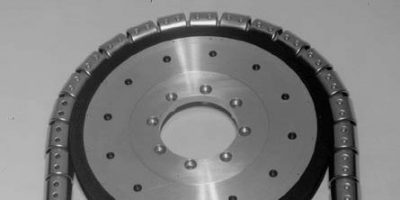
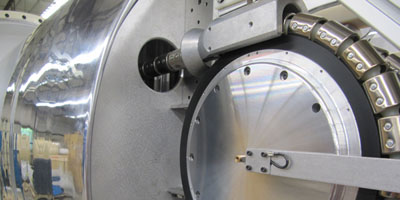
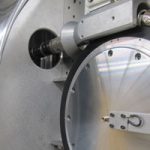
The Pelletron charging system is a core item of NEC’s accelerator technology. Due largely to the unique Pelletron charging chain, the Pelletron charging system is an all-around superior alternative to other accelerator charging systems in efficiency, longevity, durability, stability, and cost and difficulty of system maintenance.
The Pelletron charging chain used in NEC accelerators was developed in the mid 1960s as an improvement over older Van de Graaff charging belts. Though other charging systems, such as solid state systems, have also been designed to replace the belt, the Pelletron chain has proven to achieve superior terminal voltage stability and exceptional durability. NEC has used the pellet charging chain design for over 50 years. They have proven to last as much as a decade or more (some have run for over 40 years) before needing replacement.
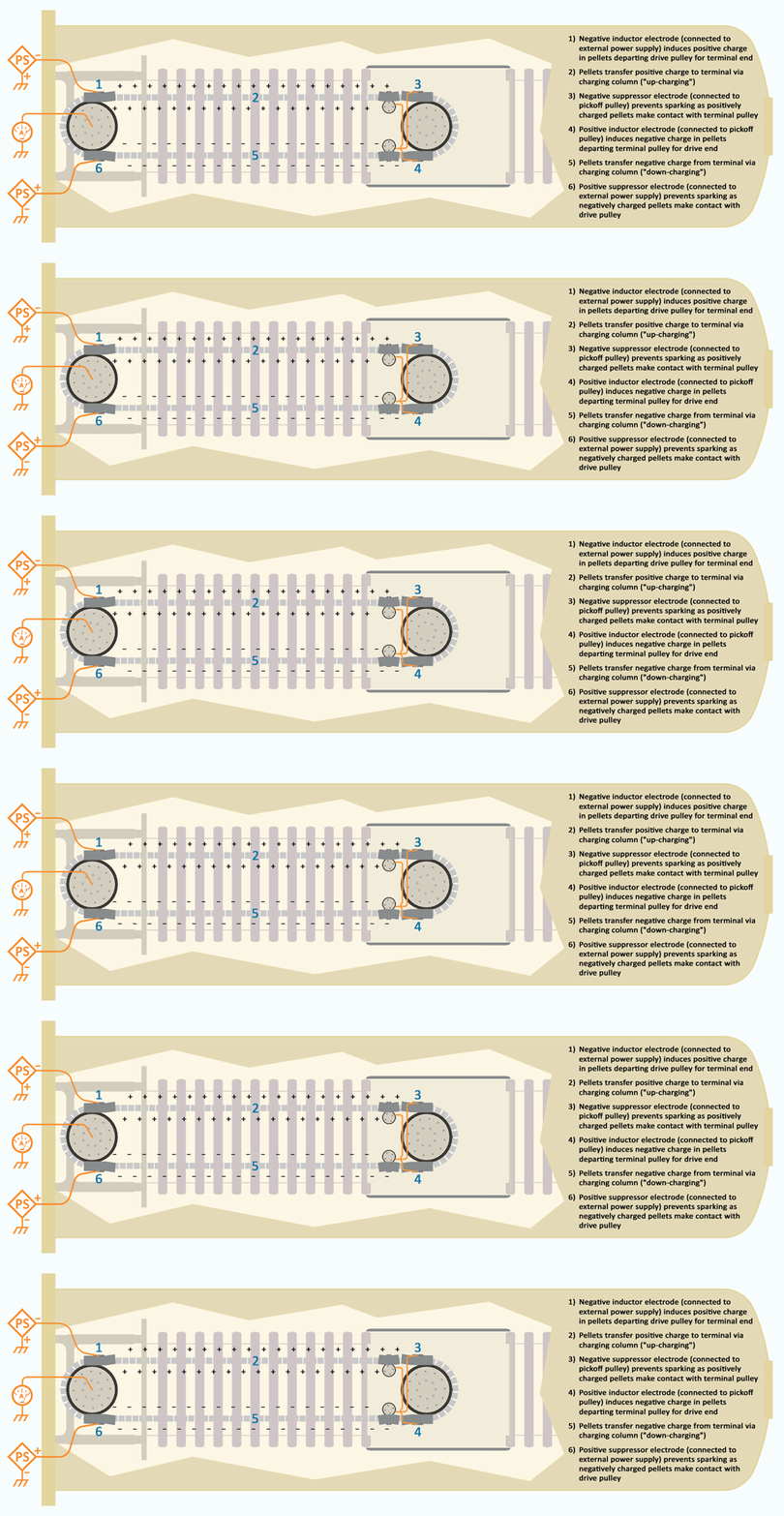
Pelletron chains are made of metal pellets connected by insulating nylon links and are charged by an induction scheme that does not use rubbing contacts or corona discharges. For a positive terminal (single ended) Pelletron, the negatively-charged inductor electrode draws positive charge onto the pellets while they are in contact with the grounded drive pulley. There is no charge transfer from the inductor electrode to the chain. Since the pellets are still inside the inductor field as they leave the pulley, they retain a net positive charge. The chain then transports this charge to the high-voltage terminal, where the reverse process occurs. When it reaches the terminal, the chain passes through a negatively-biased suppressor electrode, which prevents arcing as the pellets make contact with the terminal pulley. As the pellets leave the suppressor electrode, charge flows smoothly onto the terminal pulley, giving the terminal a net positive charge. This process is commonly referred to as “up-charging.” There is no charge transfer from electrode to the chain.
Most Pelletrons employ “down-charging” as well as “up-charging.” Down-charging works identically to up-charging, except the inductor/suppressor polarities are reversed, and it effectively doubles the charging current capacity of the chain. For the configuration shown here, small, slightly-conductive “pickoff pulleys” provide the voltages for the terminal suppressor/inductor electrodes by drawing a tiny amount of charge from the chain, each pulley thus biasing the opposing electrode. This technique allows down-charging without the use of HV power supplies in the terminal.
A partial animated view of a Pelletron charging system, showing the ground-to-terminal section of a tandem accelerator (click to view)
Depending on the particular design options, the system delivers charging currents of 100 – 200 µA or more per chain to the high voltage terminal. The drive pulleys, typically 30 cm to 60 cm in diameter, and motors are supported on linear bearing frames that are counterweighted, automatically providing proper chain tension. Pelletron systems can be equipped with 1 to 8 chains, depending on charging current required.
Over 250 Pelletron charging systems are currently in use in dozens of countries around the world as part of electrostatic ion beam accelerators. The vast majority of these are complete NEC accelerator systems, designed for a wide range of applications including Accelerator Mass Spectrometry (AMS) and Ion Beam Analysis (IBA). However, Pelletron charging systems are also available as upgrades to the belt-driven Van de Graaff charging systems in a number of HVEC accelerator models, including ESTU, MP, FN, and EN. Please contact NEC if you are interested in replacing a belt-based system with a Pelletron charging system.
©2024 National Electrostatics Corp.