The ASTM (founded as the American Society for Testing and Materials) D6866 Standard is a globally accepted sample preparation and test method that teaches how to experimentally measure biobased carbon content of solids, liquids, and gaseous samples using radiocarbon analysis. The method is applicable to any product containing carbon-based components that can be combusted in the presence of oxygen to produce CO2 gas. This method can be used to quantify biofuel blends for the airline industry or race cars, look for fraud in essential oil production, and more.
The NEC CEGS (Carbon Extraction and Graphitization System) isolates carbon from a sample and removes other elements. The SSAMS (Single Stage Accelerator Mass Spectrometer) measures the amount of 14C in small graphite samples. The two systems operate together under the ASTM D6866 Standard to effectively measure and record the carbon content of a sample.
The results from the SSAMS are typically reported as “% Biobased Carbon”. This indicates the percentage carbon from “natural” (plant or animal by-product) sources versus “synthetic” (petrochemical) sources. For reference, 0 % Biobased Carbon indicates that a material did not contain any carbon from plants or animal by-products while 100 % Biobased Carbon indicates that a material is entirely from plants or animal by-products. A value in between represents a sample has been mixed or adulterated.
The measurement is cited as percent modern carbon (pMC). This is the percentage of C14 measured in the sample relative to a modern reference standard (NIST 4990C) and compared to today’s environment.
The NEC CEGS-SSAMS system will allow users to create reports to match the ASTM D6866 method, with an example shown below.


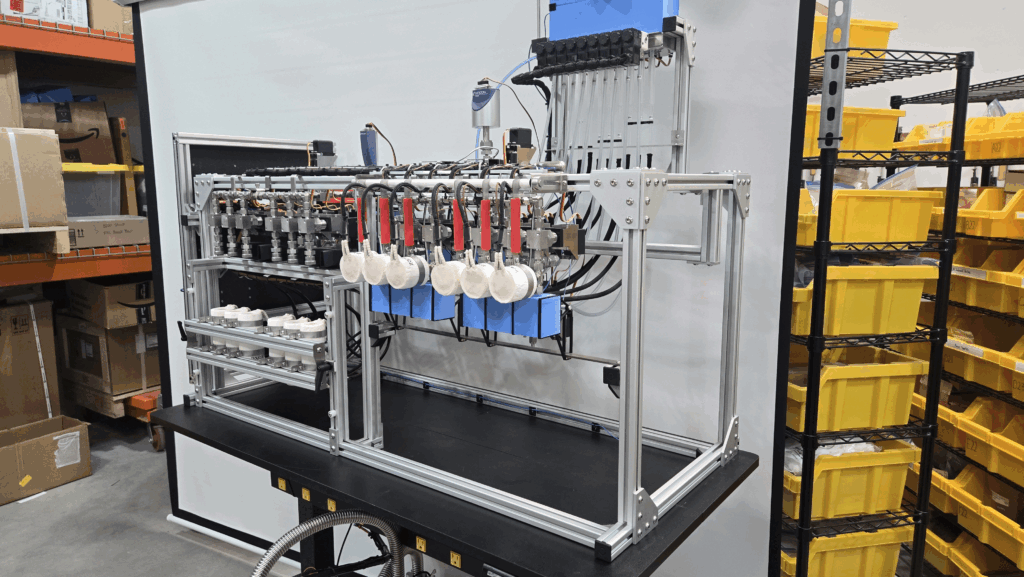
The CEGS isolates the carbon from a pre-treated sample, strips away everything else, and converts it into pure solid for radiocarbon analysis.
Several CEGS models are available, each tailored to specific needs. All models share a common core consisting of: a sample inlet manifold, process section, and graphite manifold. Built-in subsystems – including vacuum, liquid nitrogen, and control sections – provide essential support. Specialized equipment such as tube furnaces, analyzers and other instruments is readily incorporated. Even complex systems like a dedicated DIC water processor can be integrated with the CEGS.
This system automates the methods developed and still employed by the world’s leading radiocarbon research laboratories. Automation improves consistency and repeatability decreases scatter and significantly reduces per-sample labor. The CEGS is designed to capture all carbon and remove everything else. The system can capture more than 99% of sample’s CO2 at better than 99.9% purity. Competing systems may only capture 90-95% of a sample. This type of system is essential for small (<200 µgC) dilute (<3% C), or contaminated samples.
Once the CEGS has isolated the carbon and created graphite, the sample can be inserted into NEC SSAMS System to measure the amount of 14C in the sample.
The NEC Single Stage Accelerator Mass Spectrometer (SSAMS) is based around a 250 kV high voltage deck for beam energies around 285 keV. The system is optimized for world-class precision, superb throughput, and low background of radioisotope samples. The NEC SSAMS is a complete system with all necessary hardware and software for both on-line and off-line radiocarbon isotope measurements.
Once a sample has been appropriately processed and inserted into the ion source (either as graphite or CO2), the sample is converted to negative ions and is accelerated through the first bending magnet. This first mass spectrometer has a biased chamber to allow sequential injection of the negative ions of interest, allowing low energy 12C- and 13C- to be measured in offset Faraday cups. As the negative ions exit the magnet, they accelerate to higher potential energy (around 285 keV) into a gas stripper that breaks up negative molecules and converts the resulting single nuclei ions to positive ions. In this way, such ions as 12CH-, 12CH2-, 13CH-, and others are converted to single nuclei ions, 12C+, 13C+, and 14C+. This eliminates interferences that might be caused by molecular ions when counting 14C+ ions later in the system. The higher energy ions pass through the second spectrometer, resulting in an improved mass separation, allowing the abundant isotopes 12C+ and 13C+ to be measured with high precision current integrators. The rare isotope 14C+ continues through a 90° electrostatic spherical analyzer (ESA) which removes any outstanding interferences and the beam is measured in a solid state particle detector. NEC AMS systems include full computer control with AMS analysis software to provide chronological ages, carbon content in dpm/gm, or pMC (percent modern carbon) values.
NEC AMS systems can support several configurations from a single, 40 sample source, to dual 134 sample sources for a maximum throughput of 2,000 samples to 2% precision per week. Sample wheel loading takes less than 30 minutes with full 40 sample wheels typically measured to precision within about 24 hours. NEC ion sources have no noticeable memory effects and are extremely reliable. NEC has provided more than 125 MC-SNICS sources around the world.
The system proceeds automatically to switch from sample to sample as the required precisions, time constraints, or other criteria are met. The system can be monitored remotely and is fully interlocked in case of power, water, or air failure to protect personnel and precious samples.
| HV Deck | |
| Voltage Range: | to 250 kV @ 1 mA |
| Single Charged Energy Range: | to 285 keV |
| Voltage Stability: | 0.01% per hour after 1/2 hour warmup |
| Primary Components | |
| Beamline Height: | 1.4 m (40 MC-SNICS) or 1.5 m (134 MC-SNICS) |
| Pumps: | Turbo molecular pumps, rough backing pumps |
| Vacuum System Base: | 5e-7 Torr, or better (without beam) |
| Ion Source(s)/Injector: | Injection voltage, ~30-40 keV
40 or 134 MC-SNICS (carbon) |
| Acceptance Test Values | |
| Carbon, Terminal Potential: | 250 kV |
| 12C- (Pulsed Beam): | Current > 40 µA |
| Beam Transmission: | > 40% |
| 14C/12C (abundant ratio 1e -12) | Precision < 0.2% |
| 13C/12C (abundant) | Precision < 0.2% |
| 14C/12C (background) | Ratio < 1e-15 |
| 14C/12C (CO2 abundant) | Precision < 0.8% |
| 14C/12C (CO2 background) | Ratio < 8e-15 |
©2026 National Electrostatics Corp.